

Why You’ll Love This Orange Pound Cake Recipe
Author: Stella Romano
My blog shares my passion for cooking by offering a variety of recipes that are simple and accessible to everyone. My ambition is to inspire readers to explore new flavors, cook with joy, and create memorable moments around the table.
The Orange Pound Cake Recipe is a cozy, citrus-scented loaf that works for breakfast, afternoon tea, or a light dessert. It is friendly to busy schedules and rewarding for bakers at every level. Read on for clear steps, smart tips, and variations to make this cake your go-to citrus loaf.
- Ease of preparation: This recipe uses straightforward techniques: cream butter and sugar, add eggs one at a time, fold in dry ingredients, and bake. Total hands-on time is about 30 minutes with 70 minutes in the oven for predictable results.
- Health benefits: Fresh orange zest and juice add vitamin C and bright flavor without extra artificial ingredients. Portion-controlled slices help satisfy a sweet craving without going overboard on added fats or processed flavors. For more about the benefits of oranges, check this resource: + $(‘AI Agent’).item.json.output.Anchor1 +.
- Versatility: The base batter accepts swaps for milk, flour, or citrus, so you can adapt it to dietary needs or ingredient availability. Serve plain, syrup-soaked, or glazed for different occasions.
- Distinctive flavor: Zest of three large oranges plus an orange syrup creates a bright, tangy finish that cuts through the cake’s buttery richness for a balanced bite.
Essential Ingredients for Orange Pound Cake Recipe
All ingredients below include precise measurements so you can gather everything before you start. The list is split between cake, syrup, and optional drizzle.
Main Ingredients
- 230 grams (1 cup or 2 sticks) unsalted butter, softened – provides richness and tender crumb
- 200 grams (1 cup) caster sugar or granulated sugar – sweetens and helps with creaming for air incorporation
- 3 large eggs, room temperature – binders that add structure and moisture
- Zest of 3 large oranges – concentrated orange flavor without extra liquid
- 280 grams (2 cups) plain flour or all-purpose flour – the cake’s base; weighs give more consistent results than cups
- 1 teaspoon baking powder – helps the dense batter rise evenly
- 1/4 teaspoon salt – balances sweetness and brightens flavors
- 120 ml (1/2 cup) full fat or whole milk, room temperature – adds moisture and softens the crumb
For the Orange Syrup
- 45 ml (3 tablespoons) freshly squeezed orange juice – liquid for the syrup that soaks into the warm cake
- 70 grams (1/3 cup) caster sugar or granulated sugar – dissolves into a glossy syrup to lock in moisture
For the Orange Drizzle (optional)
- 3 tablespoons icing sugar or powdered sugar, sifted – creates a smooth, sweet glaze
- 2-3 teaspoons fresh orange juice – thins the glaze and adds fresh citrus flavor
Special Dietary Options
- Vegan: Replace butter with 230 grams vegan butter or coconut oil, swap eggs for 3 tablespoons aquafaba or 3/4 cup applesauce, and use plant milk for 120 ml. Use a vegan egg replacer if you prefer.
- Gluten-free: Replace 280 grams plain flour with a 1-to-1 gluten-free baking flour blend and add 1/4 teaspoon xanthan gum if your blend lacks it. Measure by weight for best results.
- Low-calorie: Reduce butter slightly to 180 grams and use a granulated sugar substitute measured to taste. Use low-fat milk instead of full fat, and keep the syrup light or skip it.
How to Prepare the Perfect Orange Pound Cake Recipe: Step-by-Step Guide
This step-by-step walk-through uses the provided times and temperatures. Read each step first, then work confidently. Subheadings break the long section into manageable parts.
First Step: Prep and mise en place (10 minutes)
Preheat your oven to 170°C (340°F) standard or 150°C (300°F) fan-forced. Grease and line a loaf pan with baking or parchment paper so the cake lifts out easily after baking. Bring butter, eggs, and milk to room temperature; this helps the ingredients combine smoothly and reduces the chance of curdling when eggs are added.
Second Step: Cream butter and sugar (5-7 minutes)
Place 230 grams softened unsalted butter and 200 grams sugar in a large mixing bowl. Using an electric mixer, start on low speed to combine, then increase to medium. Beat until the mixture is pale, creamy, and slightly fluffy. Proper creaming adds small air pockets that help the dense batter rise evenly.
Third Step: Add eggs and orange zest (3-4 minutes)
Add the 3 large eggs one at a time, beating briefly after each addition. Scrape down the bowl sides with a spatula between additions to keep everything even. Stir in the zest of 3 large oranges so the citrus oils distribute through the batter and give a bright scent.
Fourth Step: Combine dry ingredients and milk (3-5 minutes)
Sift or whisk together 280 grams plain flour, 1 teaspoon baking powder, and 1/4 teaspoon salt to ensure even leavening. Add the flour mixture and 120 ml full fat or whole milk alternately to the bowl, mixing on low speed until the batter becomes smooth and thick. Stop mixing as soon as everything is incorporated to avoid developing gluten that would make the cake tough.
Fifth Step: Bake the batter (70 minutes)
Pour the batter into the prepared loaf pan and smooth the top. Bake for about 70 minutes or until a skewer inserted into the center comes out clean. Check at 60 minutes because ovens vary; if the top browns too quickly, cover loosely with aluminium foil. Note that cracking on top is normal for dense pound cake batter and does not affect the finished texture.
Final Step: Syrup soak and optional drizzle (15 minutes plus cooling)
Cool the cake in the pan on a wire rack for 10 minutes. While the cake rests, mix 45 ml freshly squeezed orange juice and 70 grams sugar to make the syrup. Pour the syrup over the warm cake in the pan so it soaks into the cracks and settles sugar on the crust. Remove the cake from the pan using the parchment paper and cool completely on a wire rack.
For an optional orange drizzle, mix 3 tablespoons icing sugar with 2-3 teaspoons fresh orange juice until smooth and drizzle over the cooled cake. Slice and serve.
Tip: Poking a few small holes in the top of the warm cake before pouring syrup helps the juice soak in more deeply for a moister loaf.

Dietary Substitutions to Customize Your Orange Pound Cake Recipe
This section gives clear swaps for common dietary needs. Each subsection focuses on a different group of ingredients.
Protein and Main Component Alternatives
If you need to swap the eggs or dairy in this Orange Pound Cake Recipe, follow these options.
- Egg alternatives: Use 3 tablespoons aquafaba (whip briefly) or 3/4 cup applesauce for a denser but moist cake. Commercial egg replacers can also work follow package directions.
- Butter swaps: Replace 230 grams unsalted butter with 230 grams vegan butter or refined coconut oil for a non-dairy version. Note that coconut oil can add a mild coconut note.
- Milk alternatives: Use 120 ml oat milk, almond milk, or soy milk in the same amount. For a creamier crumb, pick a higher-fat plant milk like oat or soy.
Vegetable, Sauce, and Seasoning Modifications
These swaps change flavor or fit seasonal produce.
- Zest and juice swaps: Make a lemon pound cake by substituting lemon zest and juice in equal amounts. This keeps the structure identical but changes the citrus profile.
- Spice additions: Add 1 teaspoon ground cardamom or 1/2 teaspoon cinnamon for warmth. Keep additions modest so the orange stays the star.
- Fruit add-ins: For a studded loaf, fold in 75-100 grams chopped candied orange peel or 1/2 cup fresh blueberries at the end. Toss fruit in a tablespoon of flour first to prevent sinking.
Mastering Orange Pound Cake Recipe: Advanced Tips and Variations
Go beyond the basic recipe with these professional tips and creative variations. This section includes how-to techniques, flavor swaps, and presentation ideas to make the cake look and taste special.
Pro cooking techniques
- Room-temperature ingredients: Always start with butter, eggs, and milk at room temperature. This improves emulsification and creates a smoother batter.
- Proper creaming: Beat butter and sugar for 5 to 7 minutes until pale and airy. This traps fine air bubbles that help lift the dense batter.
- Even baking: Use an oven thermometer to verify oven temperature. Rotate the loaf pan halfway through baking if your oven has hot spots.
Flavor variations
- Orange and almond: Add 1/2 teaspoon almond extract and 50 grams ground almonds for a nutty, fragrant loaf.
- Orange and ginger: Stir in 1 teaspoon finely grated fresh ginger or 1/2 teaspoon ground ginger for a warming bite.
- Syrup swaps: Replace orange syrup with a light honey syrup (2 tablespoons honey + 2 tablespoons water) for a different sweetness profile.
Presentation tips
- Garnish with thin orange slices or candied peel on top of the glaze for a fresh look.
- Slice with a serrated knife and wipe the blade between cuts for tidy pieces.
- Serve with a dollop of whipped cream or a scoop of vanilla ice cream for dessert.
Make-ahead options
- Bake ahead: The cake keeps well at room temperature in an airtight container for up to 3 days. For longer storage, freeze slices individually wrapped for up to 3 months.
- Partial prep: Prepare the batter and transfer to the lined pan; cover and refrigerate for up to 8 hours before baking. Bring to room temperature briefly before baking for best rise.
How to Store Orange Pound Cake Recipe: Best Practices
Follow these storage and reheating tips to keep your orange pound cake moist and flavorful.
Refrigeration
Store cake in an airtight container at room temperature for up to 3 days. If you need to refrigerate (for example if topped with fresh cream or fruit), wrap slices tightly in plastic wrap and place in an airtight container to prevent drying refrigerated cake will firm but remains tasty for up to 7 days. Bring to room temperature before serving to soften the crumb.
Freezing
Freeze individual slices or the whole cooled cake wrapped tightly in plastic wrap and then in foil. Place in a freezer bag and store for up to 3 months. Thaw overnight in the fridge or at room temperature. A syrup-soaked cake freezes especially well and keeps moisture locked in.
Reheating
Warm slices in a microwave for 12-20 seconds or in a 160°C (320°F) oven for 5-7 minutes to freshen texture. Avoid overheating or the crumb will dry.
Meal prep considerations
Cut into portions and store individually for grab-and-go breakfasts or snacks. If you plan to transport the cake, keep the glaze separate and add it just before serving to avoid smudging.

FAQs: Frequently Asked Questions About Orange Pound Cake Recipe
Why does my orange pound cake crack on top?
Cracking on top is completely normal for orange pound cake and most pound cakes. The batter is thick and dense, requiring a long bake time. The outer edges and top set first, while the center continues rising and pushes through the crust, creating splits. This gives a rustic look and perfect spots for syrup or glaze to seep in. To minimize large cracks, ensure your oven is accurately preheated, use room-temperature ingredients for even mixing, and avoid opening the oven door too early. Bake in a 9×5-inch loaf pan at 325°F for about 60-70 minutes, or until a toothpick comes out clean. The cracks don’t affect taste or texture—your cake will still be moist and flavorful with bright orange notes.
Can I make lemon pound cake using an orange pound cake recipe?
Yes, easily swap to make a lemon pound cake. Replace the orange zest and juice with equal amounts of fresh lemon zest (from 2-3 lemons) and 1/4 cup lemon juice. Keep all other ingredients and steps the same for a tangy twist. This substitution works because both citrus add moisture, acidity for tenderness, and vibrant flavor without altering the batter’s structure. For the syrup and glaze, use lemon juice instead of orange for matching taste. Test doneness at 60 minutes since citrus intensity can slightly affect baking time. Result: a zesty, buttery cake perfect for tea time or dessert, storing just as well as the original.
Do I have to use syrup or glaze on orange pound cake?
No, the syrup and glaze are optional but recommended for extra moisture and shine. The base orange pound cake is delicious on its own, thanks to butter, sugar, and fresh orange zest/juice that keep it tender. The simple orange syrup (1/2 cup juice + 1/2 cup sugar, simmered) soaks in while warm, adding juiciness without sogginess—poke holes with a skewer for best absorption. The glaze (powdered sugar + orange juice) is purely decorative and sets quickly. Skip both for a simpler cake, use only syrup for subtle enhancement, or both for showstopper presentation. Without them, enjoy within 2 days for peak freshness.
How do I store orange pound cake?
Store orange pound cake in an airtight container at room temperature for up to 3 days—it’s best eaten fresh on day one when flavors peak. Cover loosely with plastic wrap if adding glaze to prevent sticking. For longer storage, refrigerate slices wrapped in plastic for up to a week, though texture may firm up; bring to room temp before serving. To freeze, wrap individual slices or the whole cooled cake tightly in plastic wrap then foil, and place in a freezer bag for up to 3 months. Thaw overnight in the fridge or at room temp. Avoid direct fridge storage without wrapping to prevent drying out. Pro tip: syrup-soaked cake freezes exceptionally well.
How can I prevent a dry orange pound cake?
Avoid a dry orange pound cake by measuring ingredients accurately (use a scale for flour), beating butter and sugar until pale and fluffy (5-7 minutes), and incorporating room-temp eggs one at a time. Fresh orange juice and zest provide natural moisture—use 1/4 cup juice from 2 oranges. Don’t overbake: check at 60 minutes with a toothpick; center should be moist. Brush with syrup immediately after baking to lock in tenderness. Use cake flour for a softer crumb if desired, sifting it first. Store properly as noted to maintain moisture. These steps yield a dense yet moist cake with citrus brightness that stays fresh longer than basic versions.
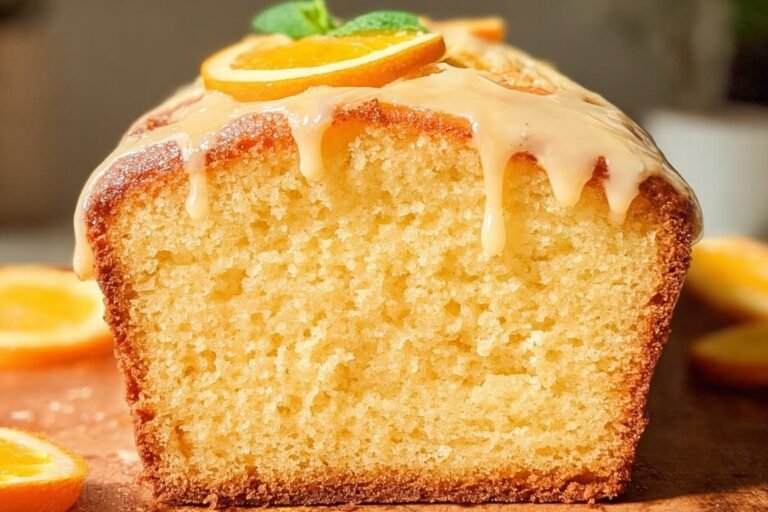
Orange Pound Cake Recipe
🍊 Experience the perfect balance of bright citrus flavor and rich buttery texture in this incredibly moist pound cake that melts in your mouth
🎂 Create a show-stopping dessert that combines the tangy freshness of oranges with classic pound cake elegance for any special occasion
- Total Time: 1 hour 40 minutes
- Yield: 8–10 servings 1x
Ingredients
230 grams unsalted butter for richness and tender crumb
200 grams caster sugar for sweetening and creaming
3 large eggs for binding and structure
zest of 3 large oranges for orange flavor
280 grams plain flour for cake base
1 teaspoon baking powder for rising
1/4 teaspoon salt for balancing sweetness
120 ml full fat milk for moisture
45 ml orange juice for syrup
70 grams caster sugar for syrup
3 tablespoons icing sugar for glaze
2–3 teaspoons orange juice for glaze
Instructions
1-First Step: Prep and mise en place (10 minutes) Preheat your oven to 170°C (340°F) standard or 150°C (300°F) fan-forced. Grease and line a loaf pan with baking or parchment paper so the cake lifts out easily after baking. Bring butter, eggs, and milk to room temperature; this helps the ingredients combine smoothly and reduces the chance of curdling when eggs are added.
2-Second Step: Cream butter and sugar (5-7 minutes) Place 230 grams softened unsalted butter and 200 grams sugar in a large mixing bowl. Using an electric mixer, start on low speed to combine, then increase to medium. Beat until the mixture is pale, creamy, and slightly fluffy. Proper creaming adds small air pockets that help the dense batter rise evenly.
3-Third Step: Add eggs and orange zest (3-4 minutes) Add the 3 large eggs one at a time, beating briefly after each addition. Scrape down the bowl sides with a spatula between additions to keep everything even. Stir in the zest of 3 large oranges so the citrus oils distribute through the batter and give a bright scent.
4-Fourth Step: Combine dry ingredients and milk (3-5 minutes) Sift or whisk together 280 grams plain flour, 1 teaspoon baking powder, and 1/4 teaspoon salt to ensure even leavening. Add the flour mixture and 120 ml full fat or whole milk alternately to the bowl, mixing on low speed until the batter becomes smooth and thick. Stop mixing as soon as everything is incorporated to avoid developing gluten that would make the cake tough.
5-Fifth Step: Bake the batter (70 minutes) Pour the batter into the prepared loaf pan and smooth the top. Bake for about 70 minutes or until a skewer inserted into the center comes out clean. Check at 60 minutes because ovens vary; if the top browns too quickly, cover loosely with aluminium foil. Note that cracking on top is normal for dense pound cake batter and does not affect the finished texture.
6-Final Step: Syrup soak and optional drizzle (15 minutes plus cooling) Cool the cake in the pan on a wire rack for 10 minutes. While the cake rests, mix 45 ml freshly squeezed orange juice and 70 grams sugar to make the syrup. Pour the syrup over the warm cake in the pan so it soaks into the cracks and settles sugar on the crust. Remove the cake from the pan using the parchment paper and cool completely on a wire rack. For an optional orange drizzle, mix 3 tablespoons icing sugar with 2-3 teaspoons fresh orange juice until smooth and drizzle over the cooled cake. Slice and serve.
Last Step:
Please leave a rating and comment letting us know how you liked this recipe! This helps our business to thrive and continue providing free, high-quality recipes for you.Notes
🌡️ Use room temperature butter and eggs to help combine ingredients smoothly and avoid curdling for the best texture
⚖️ Weigh dry ingredients to prevent adding too much flour, which can make the cake dry and tough
🔪 Check doneness with a skewer in multiple spots because pound cake batter is thick and dense – cracking on top is normal and creates great spots for syrup soaking
- Prep Time: 30 minutes
- Cook Time: 70 minutes
- Category: Dessert
- Method: Baking
- Cuisine: American
- Diet: Vegetarian
Nutrition
- Serving Size: 1 slice
- Calories: 413
- Sugar: 30.4g
- Sodium: 89.7mg
- Fat: 20.6g
- Saturated Fat: 12g
- Unsaturated Fat: 7g
- Trans Fat: 0g
- Carbohydrates: 52.8g
- Fiber: 1g
- Protein: 5.5g
- Cholesterol: 106mg